-
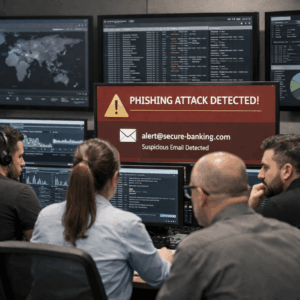
Understanding the Latest Phishing Trends: Insights from Q4 2025 Reports
Introduction:Phishing remains the top threat to organizations in 2025, but the landscape is evolving rapidly. Recent reports from KnowBe4 (October 2025) and SpyCloud (December 2025) provide an up-to-date view, with quantitative data on attack volumes, AI usage, and the impact on enterprise and business accounts. Increase in Attack Volume:According to the KnowBe4 Phishing Threat Trends…
-

The Cost of One Click: How Small Security Gaps Become Business Risks
In many organizations, security incidents are still associated with large-scale breaches, sophisticated attacks, or system-wide failures. But in reality, some of the most damaging incidents start with something much smaller. A single click. A quick approval. A moment of routine action taken without a second thought. What makes these incidents dangerous is not their technical…
-

Understanding Phishing Threats in the Age of Agentic AI
The risk that a phishing attack will cause significant damage no longer depends solely on the success of a single phishing message. In an era where Agentic AI tools operate within organizational environments, on employee devices and SaaS systems, an initial breach via phishing can quickly escalate into a broad, ongoing, and autonomous incident. Agentic…
-

Information Security in the Era of Hybrid Work
Organizations invest significant resources in protecting their systems, networks, and corporate accounts. Hybrid work has become the standard in most companies: some work is done in the office, some from home, and some in other locations. This flexibility has improved productivity, employee experience, and work-life balance, but it has also created a situation where organizational…
-

Enterprise Application Vulnerabilities: The Hidden Risk
Enterprise applications are at the core of modern business operations. CRM systems, ERP platforms, internal portals, mobile workforce apps, and countless custom built tools enable productivity, automation, and scale. However, these same applications often represent one of the most underestimated security risks inside the organization. Unlike external attacks that target network perimeters, application level vulnerabilities…
-
Why Traditional Cybersecurity Metrics Are No Longer Enough
Traditional cybersecurity metrics are no longer sufficient to reflect real security effectiveness. Many organizations still rely on measurements such as time to detection, number of alerts, or number of incidents handled. While these indicators have value, they fail to address the most critical question: how much damage had already occurred by the time the incident…
-

Crypto Phishing – A Real Threat With Severe Financial Consequences
For many, phishing is still perceived as a minor issue. A suspicious email, a strange message, a link you should not click. But in the crypto world, phishing has long crossed the line from a nuisance to a very real business risk. Since late 2024 and throughout 2025, a series of incidents have been reported…
-

When SMS Attacks Fall Outside Your Security Stack
Organizations invest significant resources in protecting their systems, networks, and corporate accounts. Most of this investment focuses on familiar channels such as email, corporate endpoints, and network access. At the same time, one attack vector continues to operate with little to no organizational oversight: SMS messages. Smishing attacks do not attempt to break security systems…
-
The Rise of Multi-Channel Phishing: Email, SMS, and Collaboration Tools
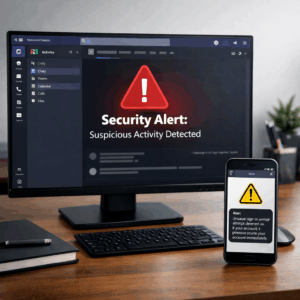
In the past, most phishing attacks focused solely on email. Today, attackers are increasingly using multi-channel strategies, targeting users via SMS, messaging apps like WhatsApp, and collaboration tools within the organization, such as Teams. These attacks present a new challenge for managers and organizations: messages appear legitimate and arrive through channels employees use regularly, making…