-

Phishing Has Left the Inbox
For years, most anti-phishing efforts focused on email. Filtering technologies improved, employees received security awareness training, and organizations invested heavily in detecting suspicious messages before they reached users’ inboxes. But while everyone was focused on email, attackers started looking for other ways to reach their targets. Today, more and more attacks begin through everyday platforms…
-

Why Do BEC Attacks Keep Increasing?
According to a recent study, 74% of organizations reported Business Email Compromise (BEC) attempts in 2025, up from 63% the previous year. In addition, 85% reported receiving messages impersonating trusted entities, while more than half encountered lookalike domains designed to mimic legitimate organizations. At first glance, these numbers seem surprising. Organizations are investing more than…
-

The Security Gap That Happens in Seconds
Many organizations today rely on a large number of security tools.There are systems that monitor networks, systems that detect threats, systems that analyze user behavior, and systems that generate alerts. On the surface, it looks like the environment is well protected. But in practice, there is one small moment where things often break. The moment…
-

Another Evolution of Phishing: Attacks That Start With a Zoom Meeting
Phishing attacks continue to evolve, and a recent campaign attributed to the North Korean hacking group BlueNoroff shows just how sophisticated these methods are becoming. Instead of sending emails with malicious links, attackers invite executives to what appears to be a legitimate Zoom meeting. During the process of joining the call, the victim is asked…
-

Sometimes Hackers Don’t Need to Hack
For years, organizations invested heavily in firewalls, network defenses, and sophisticated security infrastructure. But many modern attacks no longer start by breaking into systems. Instead, attackers simply convince someone inside the organization to open the door. A recent report about the breach at ADT illustrates this perfectly. According to reports, attackers used phishing techniques to…
-
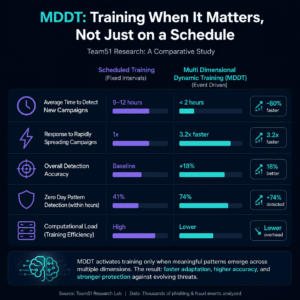
Team51 Research: Scheduled Training vs. Dynamic Training in Phishing Detection
In most machine learning systems, training happens in fixed cycles.Models are updated once a day, once a week, or after a certain volume of data has been collected. This approach is widely used and works well across many domains. But in the world of phishing and digital fraud, reality behaves differently. Attackers do not operate…
-

When Security Becomes a Bottleneck
Security is meant to protect the organization, but in many cases, it also starts to impact how fast the organization can move. This does not happen overnight.Another layer is added, another approval step is introduced, another restriction is put in place to reduce risk. Each decision makes sense on its own, often driven by real…
-
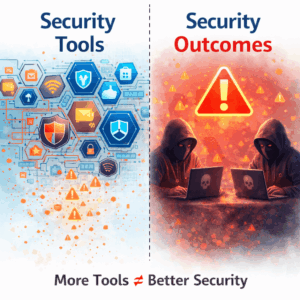
Security Tools vs. Security Outcomes
Most organizations feel secure because they have “a lot” in place – multiple systems, layered defenses, and a constant stream of alerts. On paper, it looks strong and comprehensive. But day to day, the reality is more complex. Adding more tools does not necessarily lead to better security. In many cases, it leads to more…
-

The Hidden Gap Between Detection and Action
There is a moment when a threat is detected.An alert appears, logs start to accumulate, and it feels like things are under control. But in reality, that is exactly where the gap begins. Because between detection and action, several steps still need to happen.Someone has to notice the alert, understand its meaning, decide how urgent…