
Many organizations today rely on a large number of security tools.
There are systems that monitor networks, systems that detect threats, systems that analyze user behavior, and systems that generate alerts.
On the surface, it looks like the environment is well protected.
But in practice, there is one small moment where things often break.
The moment when a user is about to click a link.
At that point, most security systems have already done their job.
Detection systems may have flagged suspicious activity. Monitoring tools may have generated alerts. Analytical systems may have identified unusual patterns.
But the user still sees a message, a link, or a page that appears legitimate.
And the decision is made within seconds.
This short window is where many attacks succeed.
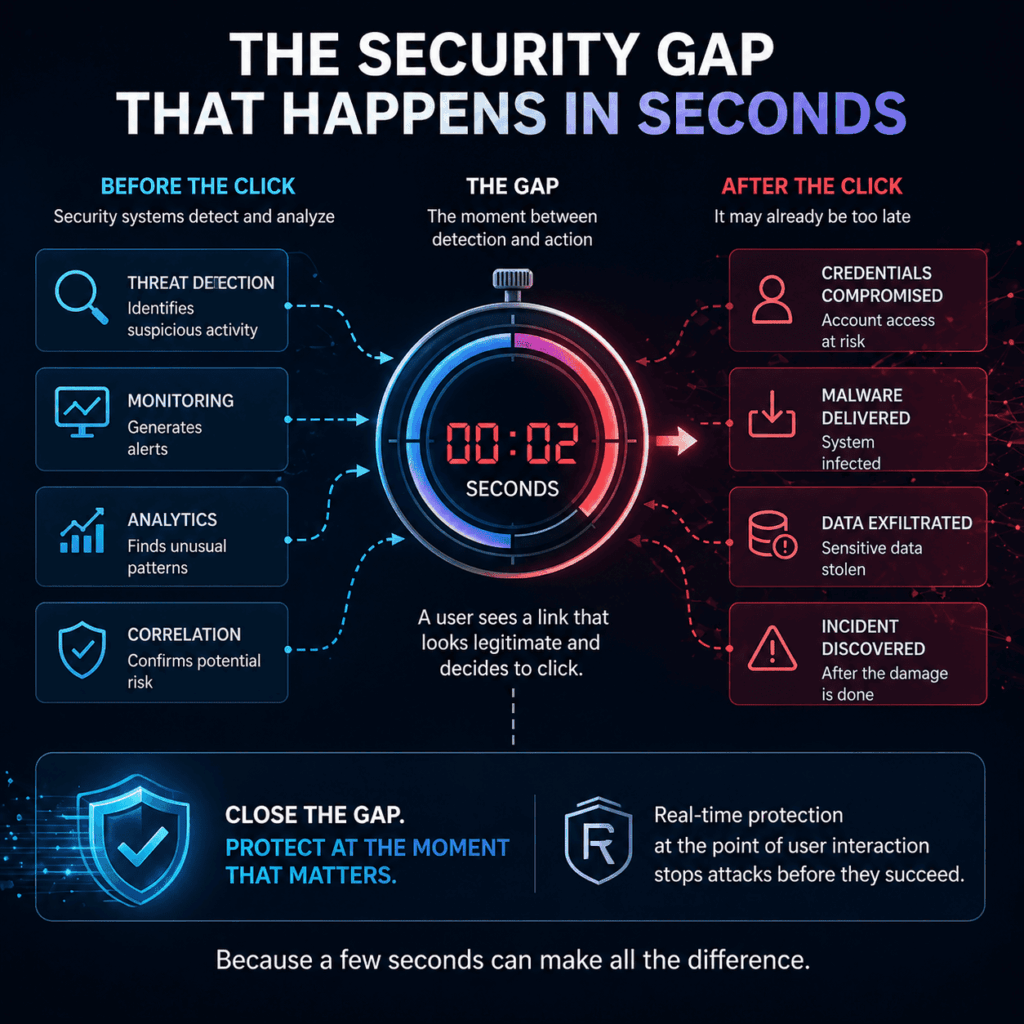
In many cases, organizations only discover the incident afterward, when a user has already clicked the link, entered credentials, or downloaded a file.
That is why one of the central challenges in cybersecurity today is not only detecting threats, but preventing them at the exact moment an action takes place.
The gap between threat detection and the user’s action is often only a matter of seconds.
But in the world of phishing and digital fraud, a few seconds can be the difference between a blocked attack and a real security incident.
This is why more security architectures are starting to focus not only on early detection or post event analysis, but also on protection that operates at the exact point of user interaction.
Because sometimes the difference between a stopped attack and a successful one happens in a single moment.