
In most machine learning systems, training happens in fixed cycles.
Models are updated once a day, once a week, or after a certain volume of data has been collected. This approach is widely used and works well across many domains.
But in the world of phishing and digital fraud, reality behaves differently.
Attackers do not operate according to the model’s training schedule.
A new campaign can emerge within minutes, spread rapidly, and reach a large number of users within hours.
In such cases, a model that waits for the next training cycle may already be behind.
To examine the impact of this gap, NTrigo’s Team51 research group conducted a comparative analysis between two training approaches:
- Scheduled Training – model training at fixed intervals
- Multi Dimensional Dynamic Training (MDDT) – training triggered by the accumulation of signals and anomalous patterns across multiple dimensions
Research Methodology
The study analyzed thousands of phishing and digital fraud events that emerged over short timeframes and introduced previously unseen patterns.
The evaluation focused on several key parameters:
- Time to detect new attack patterns
- Model adaptability to evolving campaigns
- False positives and false negatives rates
- Response time to zero day patterns
- Computational load relative to training frequency
Key Findings
The results revealed significant differences between the two approaches.
1. Detection Time for New Patterns
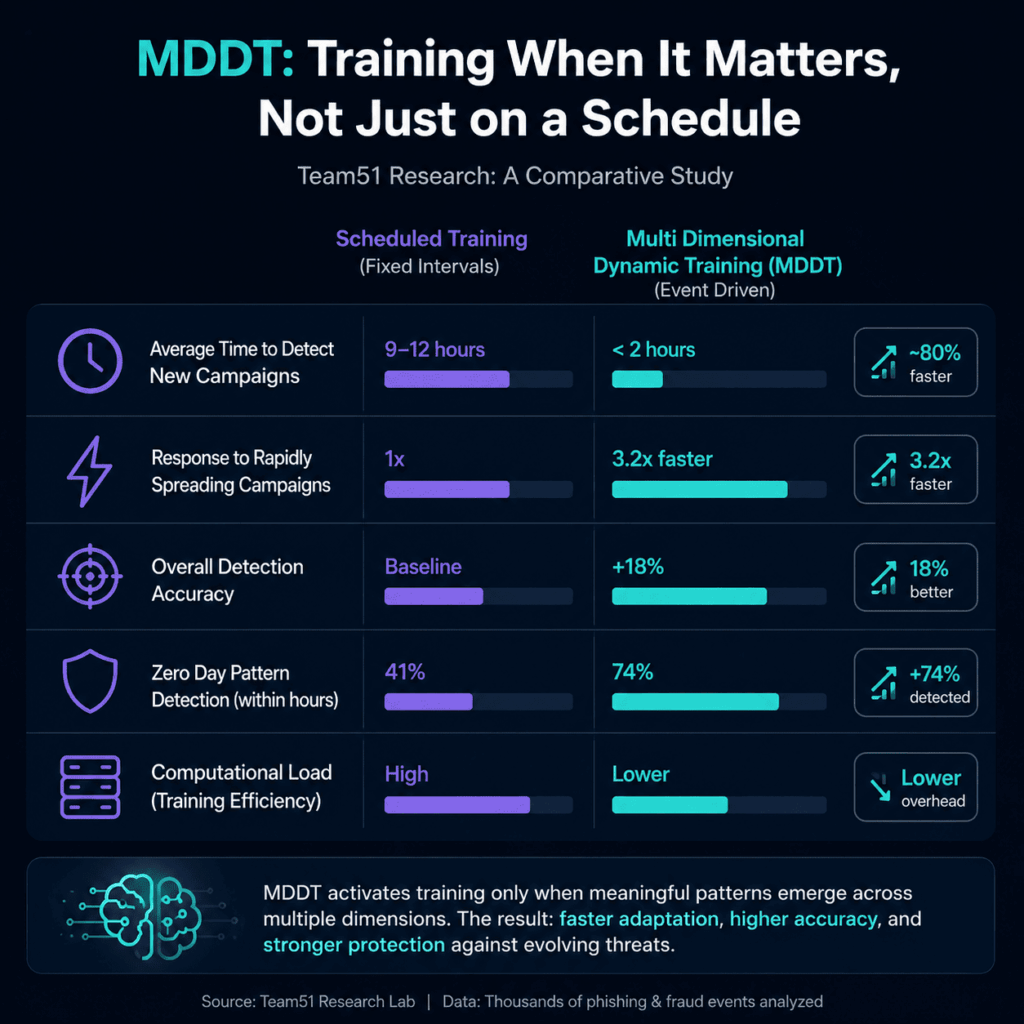
In systems relying on scheduled training cycles, the average time for the model to learn and detect a new campaign ranged between 9 to 12 hours.
With MDDT, detection time was reduced dramatically to under 2 hours on average.
This represents an improvement of approximately 80 percent in adaptation speed to new patterns.
2. Response to Rapidly Spreading Campaigns
In fast spreading campaigns, such as those using newly registered domains with similar link structures, models using dynamic training identified patterns 3.2 times faster.
This was mainly due to training being triggered by correlated signals across multiple dimensions including domains, link structures, behavioral indicators, and textual patterns.
3. Model Accuracy
Increasing training frequency alone did not significantly improve performance.
Systems that trained more frequently but still relied on fixed schedules showed only about a 6 percent improvement in detection accuracy.
In contrast, event driven training based on meaningful signal accumulation improved overall accuracy by approximately 18 percent.
4. Zero Day Detection
When completely new attack patterns appeared, MDDT based systems responded faster because training was triggered immediately upon detecting unusual sequences of signals.
In simulation tests, these systems successfully identified about 74 percent of new patterns within hours, compared to only 41 percent in systems based on scheduled training.
Why Does This Happen?
The key difference is not just how often models are trained, but what triggers the training.
Instead of relying on time based cycles, Multi Dimensional Dynamic Training (MDDT) activates learning when meaningful signal accumulation is detected, such as:
- Sudden emergence of similar link structures
- Unusual activity across multiple new domains
- Repeating characteristics of an evolving phishing campaign
When such patterns are identified, the system generates a trigger that activates the learning process immediately.
Conclusion
In an environment where phishing and digital fraud evolve rapidly, the question is not only how often models are trained, but when they are trained.
Team51’s research shows that models using dynamic, signal driven training can respond faster, detect new patterns earlier, and significantly reduce the exposure window during which new attacks remain undetected.
When threats evolve within hours, the ability to learn at the exact moment a new pattern emerges can make the difference between delayed detection and near real time response.