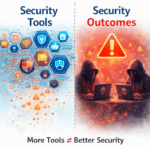
Security is meant to protect the organization, but in many cases, it also starts to impact how fast the organization can move.
This does not happen overnight.
Another layer is added, another approval step is introduced, another restriction is put in place to reduce risk. Each decision makes sense on its own, often driven by real incidents, but over time they begin to affect how work actually gets done.
Employees find themselves waiting for approvals, dealing with blocks, or changing the way they work just to “fit the system.”
Business teams feel that security is slowing them down.
Technical teams are caught between the need to protect and the need to enable speed.
At this point, workarounds begin to emerge.
At first, they are small and barely noticeable – sharing files outside approved systems, using unapproved tools, bypassing a process “just this once.” But over time, these shortcuts become habits, and the gap between policy and reality continues to grow.
This is where the balance breaks.
Security that does not integrate naturally into day-to-day workflows does not just slow the organization down – it gets pushed aside.
And once it is pushed aside, it stops being effective.
The real challenge is not just adding more layers of protection, but understanding how those layers interact with real users and real processes.
How they affect decision-making, response times, and the organization’s ability to move quickly.
Effective security is not the one that creates the most restrictions, but the one that maintains balance – protecting without blocking, enabling progress without losing control.
Because in the end, if an organization has to choose between speed and security,
it will usually find a way to bypass security.